INA8
Bremen

Economy
Ports
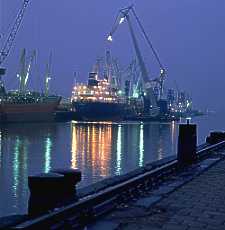
Intersection for the international flow of commodities, place of transhipment for goods from all four corners of the earth, central address for world shipping: Bremen fulfils all the criteria of an international port. The city has earned its livelihood at its ports for centuries and, as Germany's second biggest port, still does so today.
Expressed in sober economic data, Bremen's ports today still account for one third of its state product. Almost one in every three of Bremen's total of over 300,000 jobs are connected directly or indirectly with activities at the port. More than 1,000 sea-going ships per year link Bremen and Bremerhaven with more than 1,000 ports in all parts of the world. Every year nearly 30 million tonnes of goods at a total value of way over 70 billion marks are transhipped.
Modern seaports are judged by their efficiency, by the technology they implement to guarantee swift loading and unloading of the ships. Bremen's ports are among the best and fastest in the world. State-of-the-art technology dominates, the timing of merchandise movements is backed up by satellite, controlled by computer and networked worldwide. Computer specialists at logistics terminals determine the arrival and departure of ships which today link the great ports of the world with timetable punctuality. Bremen is one of those great ports.
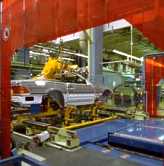
And provisions have been made for the future to make sure it maintains that status. Measures include the construction of the gigantic container terminal in Bremerhaven and the creation of one of the largest car transhipment facilities in Europe. As far as its size and efficiency are concerned, the Bremerhaven container terminal is one of the major transhipment facilities of its kind in the world, occupying the eighth position in the exclusive "container millionaires" club, a select circle of top-ranking ports that handle more than a million containers a year. Container handling is paralleled by Bremen's top position as Europe's leading international hub for car import and export. Car transhipment centres on Bremerhaven and accounts for more then 700,000 vehicles a year. German and Italian models leave Europe here, whilst at the same time, virtually all the Japanese manufacturers direct their European exports centrally via Bremerhaven.
The confusing diversity of activities at Bremen's ports also includes conventional mixed cargo, classical import commodities such as cotton, wool, coffee, tobacco and tropical fruit. Deep-frozen fish from Bremerhaven is sold all over Europe like many of the products that enter the markets of the world via Bremen, from small supply items to complete industrial plants.
Bremen's ports have two unbeatable locational advantages. The ports of the city of Bremen are 60 kilometres from the sea. No other transhipment centre in Germany lies so far inland or has such correspondingly fast connections to the hinterland. Bremerhaven, on the other hand, with its coastal location and water deep enough for ocean-going ships, is also recommended as a port of call for the world's shipping giants. Full service in Bremen, in the interests of free world trade.
High-tech
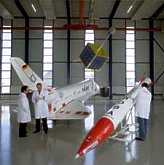
This is also one of Europe's most important aerospace centres. The "Made in Bremen" label is attached to satellite systems, to essential parts used in producing the Airbus and to Bremen's share in building "Ariane", the civilian European rocket.
Here, Mercedes-Benz builds luxury vehicles that bear its famous star, and Bremen's ports are still the internationally operating hub for a city that boasts Europe's largest self-contained terminal for container traffic and ranks first as a centre for international automobile import and export.
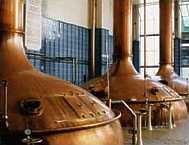
Top-class German beer has its home in Bremen, and so does the finest quality coffee. Other manufacturers enhance Bremen's gastronomic reputation with superb chocolate products, exquisite spices, a wide range of breakfast cereals and tempting fish specialities. People in Bremen, one of the most important centres of the food, beverage and tobacco industry in Europe, are connoisseurs of good food and drink.
(C) 1996 Senatskanzlei (Bremen Werbung).
[Leisure & Sightseeing][History, Politics & Curious Customs][Economy][Science][Culture][Sport] For more detailed information, please refer to http://www.bremen.de or http://www.bremen-tourism.de.
[INA8][Organizing committee][Division of Micropalaeontology][Department of Geosciences][Bremen University][City of Bremen][INA Europe][INA USA]
Copyright © 1998, most recent revision 29. August 1998
Tania Hildebrand-Habel (hiha@micropal.uni-bremen.de)