INA8
Bremen

Science
Bremen's furthest outpost lies at the South Pole. 
 Scientists freeze in the cold of the eternal ice for the sake of knowledge. They are working for the Alfred Wegener Institute, Germany's central large-scale institute for polar and marine research which is based in
Bremerhaven. As part of a worldwide network of observation systems, research into the "global chance" is being carried out here - the impact of the ozone
hole, the greenhouse effect and the shift of the continents on the earth's climate in the future. This is basic Bremen research into one of mankind's most pressing
problems.
Scientists freeze in the cold of the eternal ice for the sake of knowledge. They are working for the Alfred Wegener Institute, Germany's central large-scale institute for polar and marine research which is based in
Bremerhaven. As part of a worldwide network of observation systems, research into the "global chance" is being carried out here - the impact of the ozone
hole, the greenhouse effect and the shift of the continents on the earth's climate in the future. This is basic Bremen research into one of mankind's most pressing
problems.
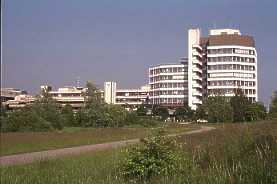 Bremen has a highly complex scientific network. A total of 25,000 students are currently registered in 25 different disciplines at the city's university and colleges.
It is also the location for 17 research institutes. A practical, application oriented approach is the principle of research in Bremen.
Bremen has a highly complex scientific network. A total of 25,000 students are currently registered in 25 different disciplines at the city's university and colleges.
It is also the location for 17 research institutes. A practical, application oriented approach is the principle of research in Bremen.
BIBA and ZARM, IWT and BIPS, ZERP and BITZ - all these abbreviations stand for close links between theory and practice. Bremen's international stature in research convinces with its successful transfer of results into concrete applications. Facilities that are closely associated with the university, such as the Bremen Institute for Production Technology and Applied Ergonomics (BIBA from the German name), the Institute for Materials Technology (IWT), the Centre for European Legal Policy (ZERP) and the Bremen Institute for Prevention Research and Social Medicine (BIPS), ensure that this transfer takes place. These institutes are leaders in their relevant fields, and other Bremen institutes are their equal in every way. Bremen owes its top position in the fields of environmental, marine and geosciences to the Max Planck Institute for Marine Microbiology and the Centre for Tropical Marine Ecology and other facilities like them. Meanwhile, to cite just two examples of excellence, the Fraunhofer Institute or Materials Research and the renowned Fibres Institute set standards in research into future-oriented materials.
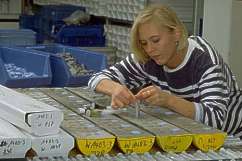 This orientation towards success is clearly visible - at BITZ, for example. Situated right near the university, the Bremen Innovation and Technology Centre has made
a name for itself as a launching pad for young enterprises. Here, ideas and technologies that emerge in the university labs are put into practice. More than 40
high-tech companies have set up here in recent years, creating a total of over 2,000 highly qualified new jobs.
This orientation towards success is clearly visible - at BITZ, for example. Situated right near the university, the Bremen Innovation and Technology Centre has made
a name for itself as a launching pad for young enterprises. Here, ideas and technologies that emerge in the university labs are put into practice. More than 40
high-tech companies have set up here in recent years, creating a total of over 2,000 highly qualified new jobs.
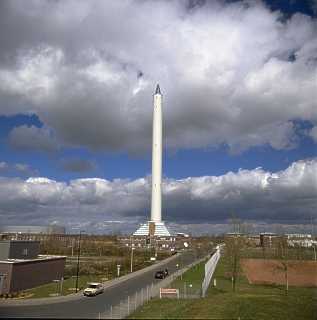
A very special kind of landmark points the way to Bremen's workshops of the future - the 146-metre high drop tower, the only one in Europe, at the Bremen Centre for Applied Space Technology and Microgravitation (ZARM from the German). In this literally towering space laboratory, experiments can be carried out under simulated weightlessness. The fall of the experimental capsule, which takes just 4.6 seconds from the top of the tower to its base, provides sufficient time for experiments and research projects that would otherwise only be possible in the natural weightlessness of outer space. Clients from all over the world use the earth-bound alternative available in Bremen - a seal of quality for science that is "Made in Bremen".
(C) 1996 Senatskanzlei (Bremen Werbung).
[Leisure & Sightseeing][History, Politics & Curious Customs][Economy][Science][Culture][Sport] For more detailed information, please refer to http://www.bremen.de or http://www.bremen-tourism.de.
[INA8][Organizing committee][Division of Micropalaeontology][Department of Geosciences][Bremen University][City of Bremen][INA Europe][INA USA]
Copyright © 1998, most recent revision 29. August 1998
Tania Hildebrand-Habel (hiha@micropal.uni-bremen.de)