INA8
Bremen

History, Politics & Curious Customs
History
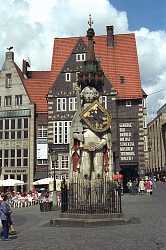
The city's history goes back over 1,200 years. And you will encounter it everywhere. In the baroque and Renaissance backdrop of the Market Square, for example, with the Town Hall and the statue of Roland, patricians' houses, and the "Schütting", Bremen's historic Chamber of Commerce. All of them are emblems of Hanseatic republican consciousness - civic pride expressed in stone, bricks and mortar. This is a tradition people in Bremen are proud of.
The historical legacy which has been salvaged from the past is lovingly tended today. Take Böttcherstrasse, for example: once a narrow street where artisans plied their trade, today it is a centre for art and culture and a highlight of European cultural history.
Then there's "Schnoor", a picturesque old-city quarter, that has been refurbished and decked out to become Bremen's most popular tourist attraction.
The modern commercial centre fits in perfectly with all of this. For preserving the old whilst trying out the new has always been a principle of Bremen's success.
Politics
Fast, direct and straightforward! If you want to get talking in Bremen, you don't need to worry about long paths through official channels. Bremen's status as the smallest of Germany's 16 states gives it indisputable advantages as far as communication and making contacts are concerned. One crucial advantage: easy access to the political leadership and quick decisions.
The structure of the Free Hanseatic City features all the levels that constitute a state: a state parliament formed by 100 members that traditionally bears the name "Bremische Bürgerschaft", a tate government as the executive body which, again the result of historical processes, is known as the "Bremer Senat" and, a seat and vote in the Bundesrat, the upper house of the German parliament formed by the states, in which Bremen, together with the other states, contributes to policy-making in the Federal Republic as a whole.
However, Bremen's compact administrative structure, adequate for a small state makes it different from the other states. There is no ministerial superstructure, no confusion over respective areas of responsibility. The administration is geared instead to the principles of transparency and nearness to the citizens, with prompt, guaranteed access to all the decision-making levels. The emphasis is on results without a bureaucratic obstacle course. This is an offer that is made to anyone who is looking for direct contact in Bremen.
Since the Bürgerschafts election of Mai 14th 1995, the Free Hanseatic City of Bremen has been ruled by a grand coalition consisting of the Social Democratic Party (SPD) and the Christian Democratic Union (CDU). The opposition parties are Bündnis 90 / DIE GRÜNEN - the German "Green" party - and the voters' action group "Employment for Bremen and Bremerhaven" (AfB).
Curious customs and traditions
1. The Spitting Stone
It's so inconspicuous that you have to look very carefully if you want to find it. The Spitting Stone is nothing more than a cobblestone with a cross embedded in it. The stone on the West side of the cathedral marks the spot where the poisoner, Gesche Gottfried, lost her life in 1831. She was the last person to be publicly executed in Bremen. Germany's "most successful poisoner" was found guilty of 15 murders and a further 15 attempted murders. And today, Bremen residents still show their disgust at her deeds with a well-aimed spit at the Spitting Stone.
2. The Lead Cellar
Mummies, coffins and horrible sights: see them all at Bremen's Lead Cellar. A phenomenon that has never been fully explained has the effect of mummifying the corpses in the crypt of the cathedral. Itinerant artisans who were expected to be transported home later were the first people laid to rest here. They were joined years afterwards by the bodies of aristocrats in the 17th and 18th centuries.
3. Sweeping the cathedral steps
A scene that is a mystery to outsiders is regularly played out here. A young man in a top hat marches up to the cathedral and sweeps for all he's worth whilst bystanders busily throw pieces of paper onto the steps. Until, that is, a young girl rescues the sweeper with a kiss. This is a ticker-tape parade, Bremen-style, and it is the fate that awaits every bachelor who reaches his 30th birthday without getting married. And while the gentlemen sweep the steps, young women of the same age have to polish the door handles until ... well, you can guess the rest for yourself!
4. "Kohl und Pinkel" - the local speciality
"Is it OK to eat that?" Of course it is! - even though it is sometimes said that Bremen's local speciality is at least as unspeakable as the "pig's stomach" the German chancellor - a native of the Rhineland - loves so much. Despite this negative view, Bremen residents swear by their favourite meal, which consists of loads of curly kale with the substantial addition a variety of meats. Pinkel is the name of a special section of pig's intestine used as a sausage skin and filled with oatmeal. Incidentally, the traditional dish is mainly eaten in the company of friends or colleagues in the course of an outing. This also explains the quintessential Bremen term "Kohl und Pinkel Fahrt" - Kohl and Pinkel Trip. Groups of Bremen citizens engaged in this custom are easily identified as they stroll in light-hearted mood through the countryside around Bremen, preferably festooned with sprigs of curly kale.
5. Freimarkt
Fun fair is not really an accurate description, although it may look like one at first glance. Bremen residents call their October "Freimarkt" their "fifth season" and celebrate it just as fervently as the Rhine-dwellers celebrate their Carnival. There are magnificent processions, closing times are suspended for pubs and the otherwise earnest Bremen citizens are transformed into the epitome of jollity and joie de vivre. The Freimarkt is also an outstanding attraction for non-natives of Bremen. It is the biggest traditional fair in the North of Germany and the oldest in Germany, dating back to 1035.
(C) 1996 Senatskanzlei (Bremen Werbung).
[Leisure & Sightseeing][History, Politics & Curious Customs][Economy][Science][Culture][Sport] For more detailed information, please refer to http://www.bremen.de or http://www.bremen-tourism.de.
[INA8][Organizing committee][Division of Micropalaeontology][Department of Geosciences][Bremen University][City of Bremen][INA Europe][INA USA]
Copyright © 1998, most recent revision 29. August 1998
Tania Hildebrand-Habel (hiha@micropal.uni-bremen.de)